Jack Reid (he/him) currently lives in a nine-person, jointly owned coop in Somerville called the Vivarium. He has been living in one coop or another (all in Camberville) since 2016. He is also the editor/webmanager of the Conviviality blog.
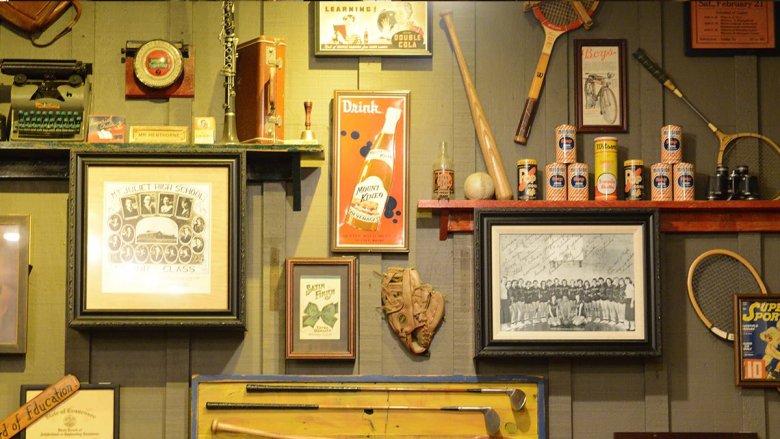
Living in a co-operative can make a variety of aspects of life easier than living alone or with just a couple of roommates. Labor can be specialized and divided. Cooking a meal for eight requires significantly less than eight times the effort for cooking for one. Social interaction is right there in your own living room. This beneficent inclinaiton does not apply to all parts of co-op life, however. More people can all too easily mean more stuff. More mess. More disorganization. More clutter. An abandoned sock in the laundry room is not easily identified and returned to its owner. Cute but space-consumptive knickknacks can quickly accumulate. A particular cooking utensil can get put away somewhere the seemed intuitive to one person but is utterly obtuse to another. And storage space can become all too scarce.
There are a few distinct basic problems at play here:
- More people means more avenues for new objects to enter the house.
- More people means the likelihood that everyone agrees on where something should go decreases.
- More people means increased risk of the bystander effect. Think “I’m sure this object is here for a reason” or “Someone else will deal with this.”
None of these are unsolvable problems, to be sure. They just require a bit more intentionality than living alone or with just one or two other people. In those cases, if something is left out, it probably belongs to you, it’s your responsibility to deal with it, and you know where it should go (or at least feel empowered to make a decision on where it should go). And if you need to find something, you probably know where it is likely to be. In a co-op, we need concrete mechanisms to get us there. Here’s a few.
Labeling
First and foremost is labeling. Get yourself a labelmaker and go to town. Drawers, cabinets, shelves, light switches, doors, you name it. Make it easy for you, new residents, and one-time guests to find stuff, be a bathroom or a glass of water. Perhaps more importantly, labels also tell people where things should get put away. Neither the dinner cook nor the dinner cleaner should have to guess where the colander comes from or goes back to: the cabinet labeled “Colanders”!
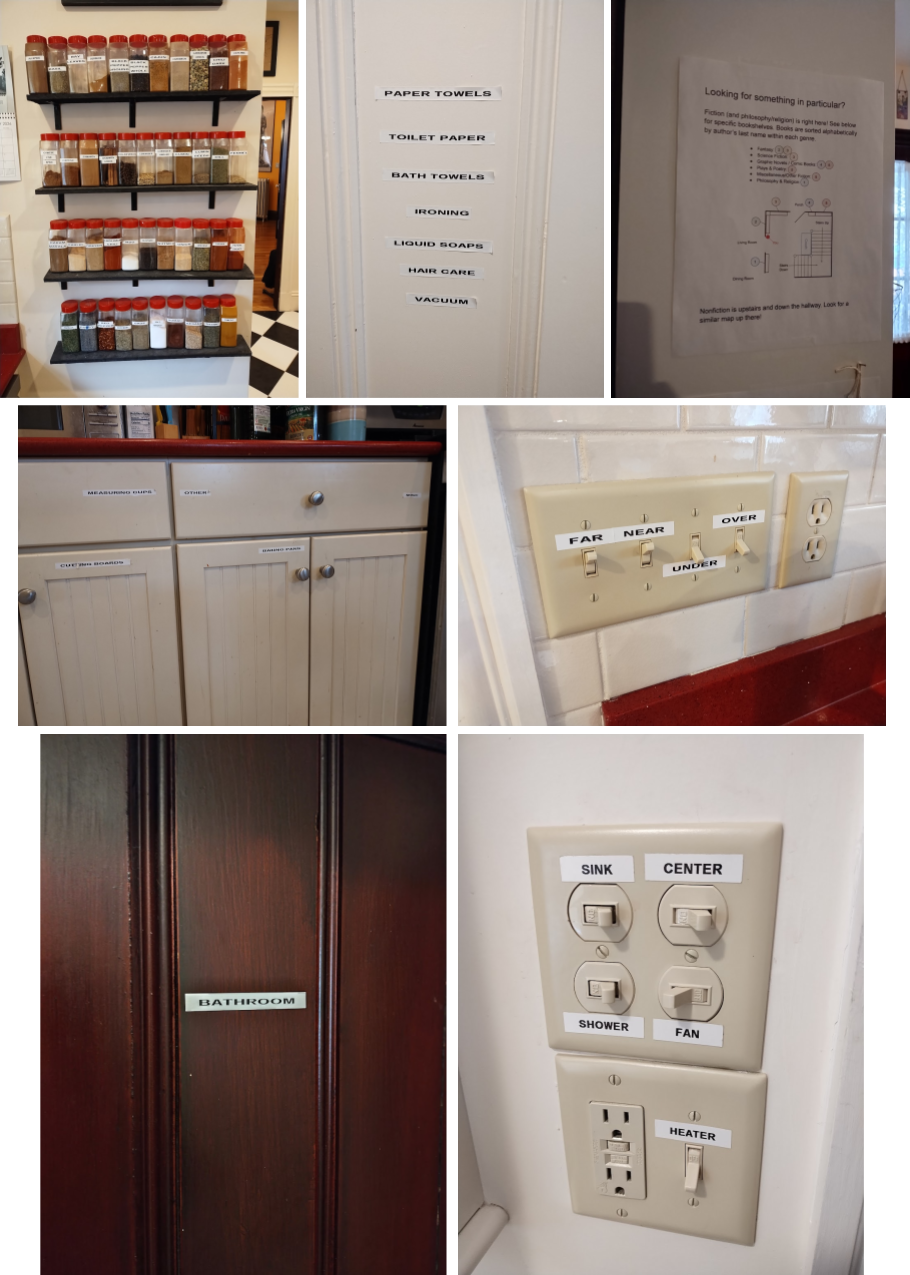 some straightforward examples from around my house
Labeling can apply to individual items as well. One co-op I lived in named their storage area “Label Your Shit” and painted that label in large, colorful letters on the door. That way, owners of objects could be identified, even if they had already moved out. And if something wasn’t labeled, well, the current residents could dispose of it however they wanted. One co-op workshop that I’m aware of placed a matching alphanumeric label on both the tool and the spot where the tool goes. The pliers with the label A15 goes on the peg labeled A15. This can be particularly useful in a large or busy space. Maybe the A in A15 refers to a particular pegboard on the wall, which has a large, prominent letter A at the top that can be seen from across the room. The 15 then refers to a particular peg on that pegboard. Another co-op that I’ve seen accomplished a similar affect without any language-based labels at all. They simply drew outlines of each tool on their pegboard. Square shape goes in the square hole, simple as that (though this lacks the “which part of the room should I look for the square hole” aspect of the alphanumeric solution).
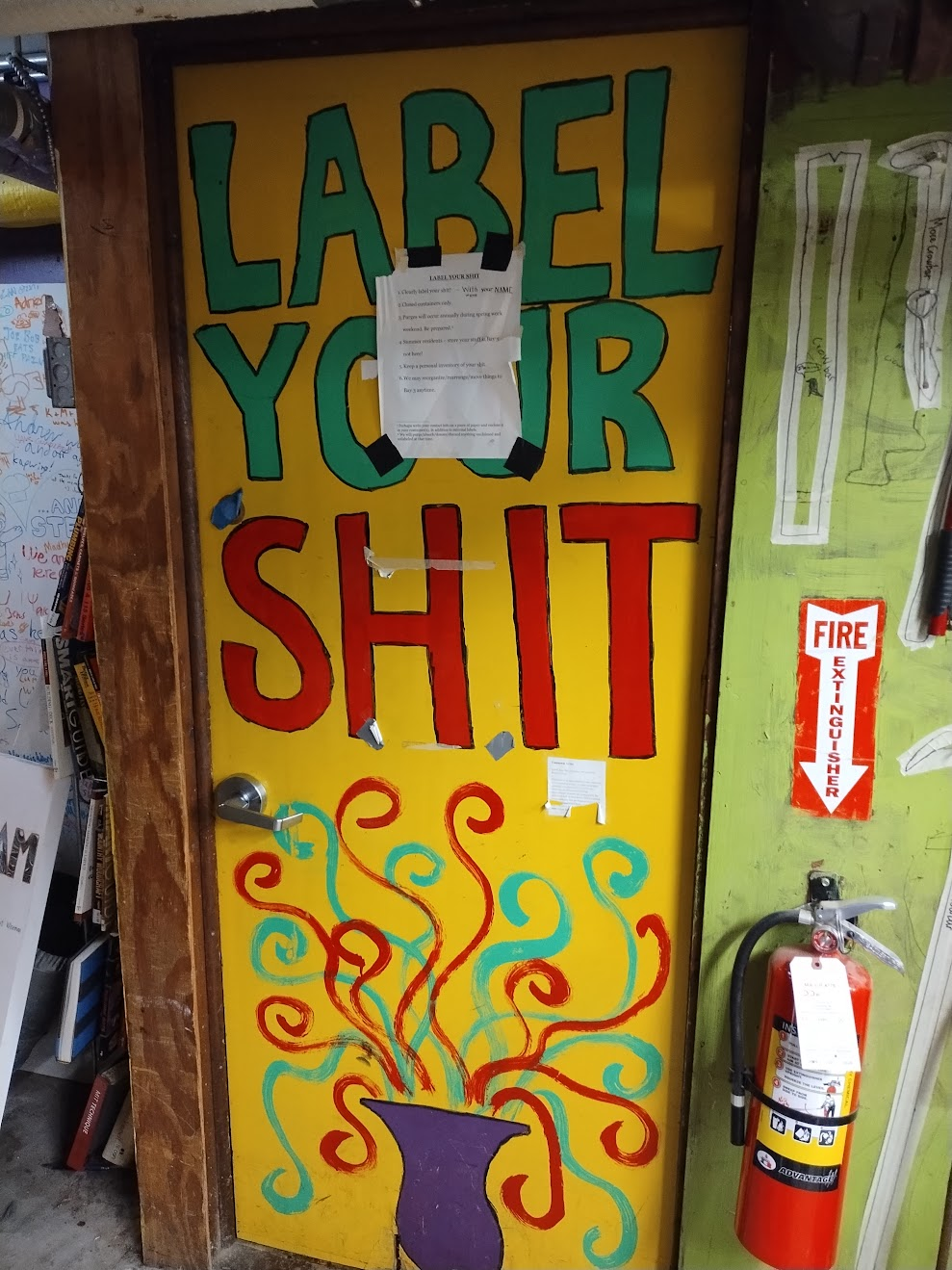 door later supplemented with even more specific labeling instructions
Generally, I’ve seen co-operatives follow a pretty similar trajectory when it comes to labeling.
First, an initial round of labeling with painters tape, sticky notes, and sharpies. This is particularly good in a new space — be it a brand new house, a recently build extension, or even just a new free-standing cabinet — where you aren’t quite sure where everything is going to go yet. If you end up deciding that mugs go to the left of the sink rather than the right, just peel off the tape and move it over! If you are unsure what objects should go where, try asking! Seriously, one co-op I know of gave guests sticky-notes and hand them place the notes where they expected to find a particular object. This guided the co-ops organizational decisions towards intuitiveness.
Second comes deploying more long-lasting, standardized labels, such as those from a label-maker. These have the benefit of easy legibility without being so permanent as to be cumbersome to replace during a re-org. This is where my current house is, a year in, for the most part.
Third, customized, permanent, and creative labeling. The painted “Label Your Shit” door is a classic example of this, as is the painted outlines of tools. Labels don’t have to be as purely functional as in the photos I shared. They can be pieces of art in their own right. Another example (from that same household) are these set of drawers.
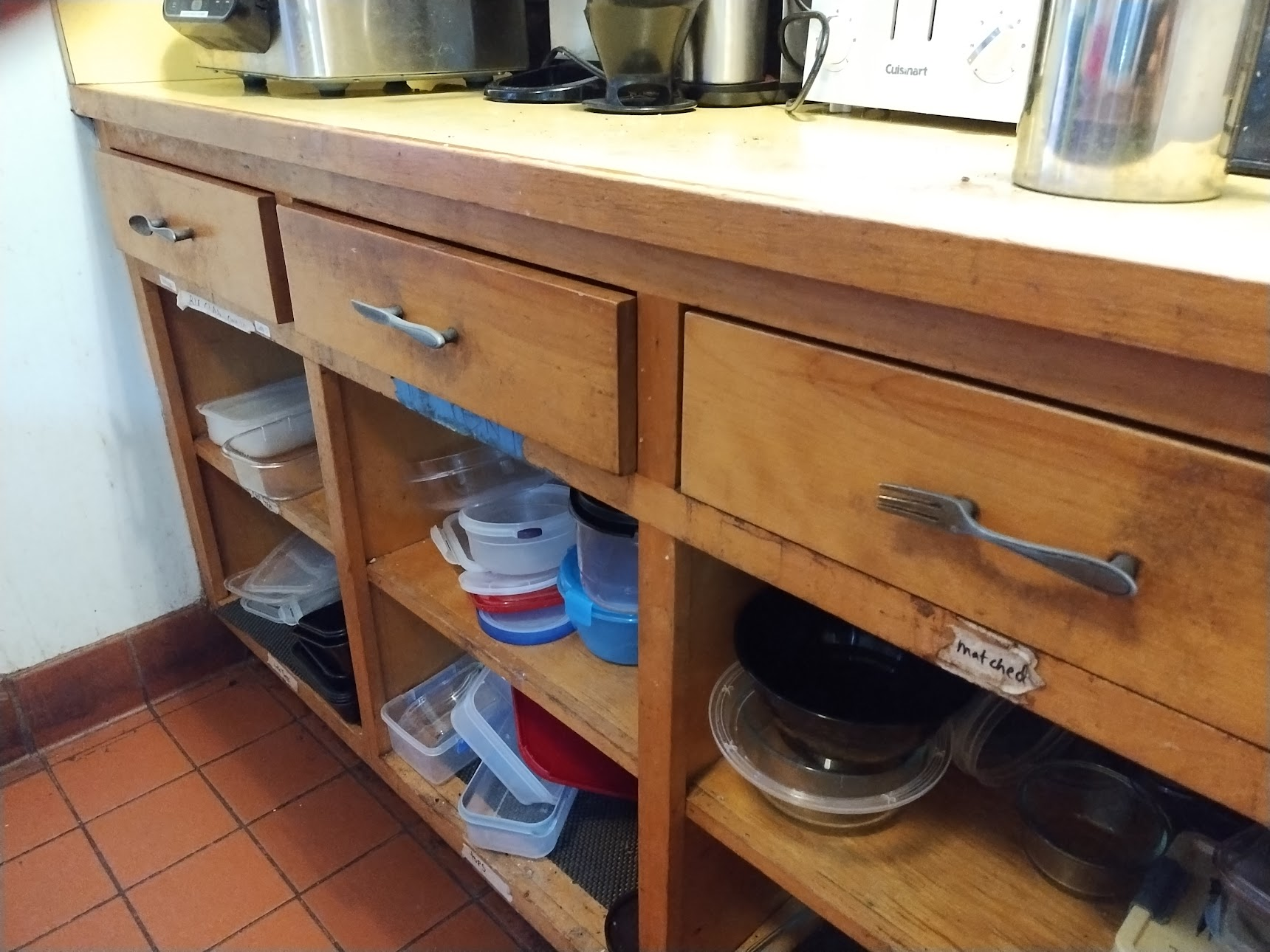 Care to hazard a guess as to what each drawer contains?
This final kind of labels are most common in long lasting co-ops. This is partly a matter of stability. If this drawer has contained specifically knives for the past decade, you can be reasonably sure that it’s going to continue to contain knives for the next decade or more. It is thus worth investing the time to make a custom label that would be a real pain to move. And I’m sure it is also partly a matter of waiting for inspiration to strike.
Storage Space (aka: go vertical)
Labeling only works if you have places to put stuff, though. And most homes are not built to accommodate any entire co-op. Every co-op I know has had to invest in their own storage solutions. A commonality to many of these solutions is the use of vertical space. This might sound obvious. A bookcase with a single shelf is just not living up to its potential, nor is a pantry with a single shelf. But lots of folks overlook all of the other vertical space in their environment. Attach hooks to your ceilings, walls, or doors. Put shelves under your worktables! Get a bedframe than enables easy storage underneath! There’s a lot of vertical bike storage options out here, from basic hooks to fancy swiveling racks. I know of one co-op that set up a pulley system in a stairwell with particularly high vertical clearance to store their bikes!
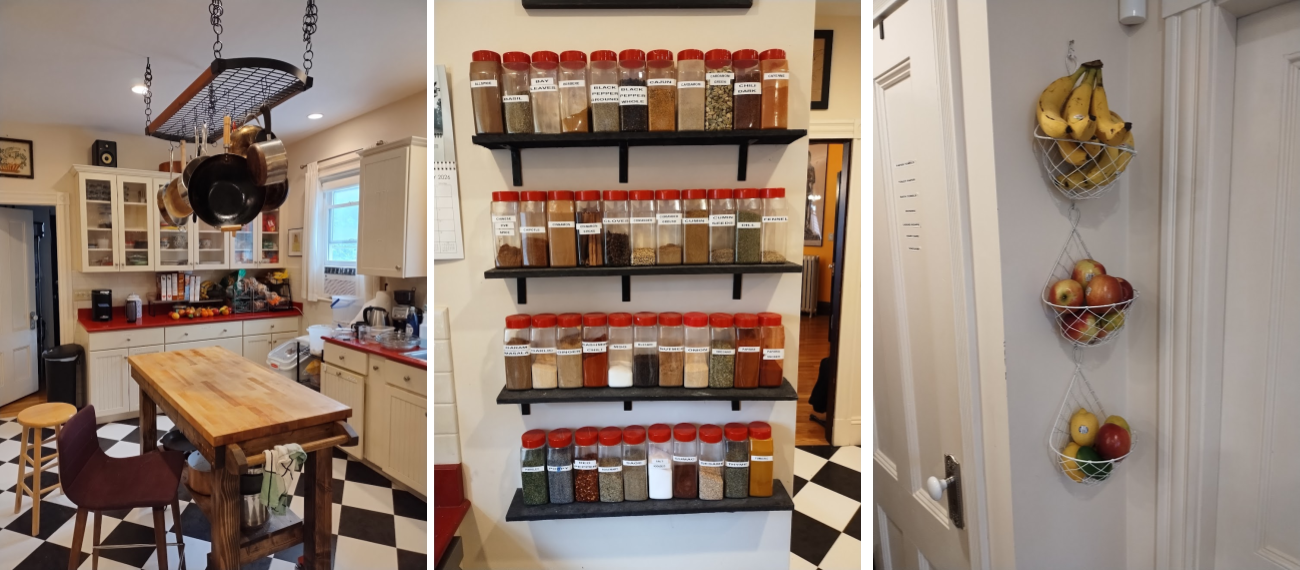 the pans above and the pots below were taking up so much cabinet space
Keep in mind that people need a place to go as well. Extra chairs can be folded or put under tables. Beds can be put on lofts. In general, a busy co-op should always turn a critical eye to an empty wall or any vertical space above a piece of furniture. Obviously vertical storage won’t work in all situations or for all people. While a generous deployment of stepladders can facilitate access, don’t put dangerously heavy objects or objects regularly needed by a reach-limited housemate up high, unless there is an easy and safe way to get them down.
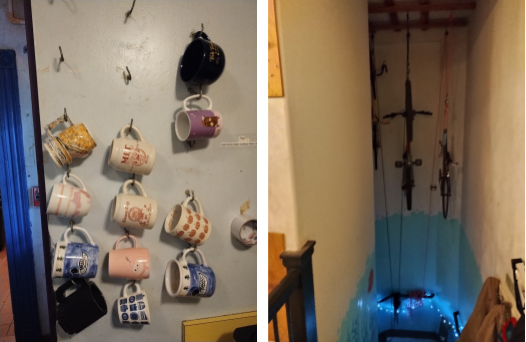 objects both small and large can go on walls, though the latter may require pulleys
The other kind of storage solution is not about opening up new horizons but simply adding a designation. If you consistently lack a place to store for a class of objects, designate a specific spot. Perhaps the most basic of these is the Lost & Found. Rather than simply ignoring or working around abandoned objects of dubious provenance, designate a specific shelf for these objects. Sock got left in the laundry room? Lost & Found. Earbuds unearthed in the couch cushions? Lost & Found. Closely related to the Lost & Found is the “Reuse,” a designated place to put objects that you don’t need anymore but you think some housemate or guest might want.
Another often useful designated storage spot is the knickknack / toys bin. Many parents will be all too keenly aware of the importance of such a bin, but it can be quite useful for a household of adults too. In our house we refer to it as “the enrichment in the enclosure” and have a couple of small bins scattered around the house for such objects. Anyone is welcome to remove such an object and use it wherever they please, but so too is anyone free to pick it up from wherever it was left and return it to one of the bins.
Designated storage spaces go hand-in-hand with labeling, of course. If a storage space isn’t labeled, how are folks supposed to know what goes there?
Practices
Labeling and organized storage space can go along way, but they can’t do the job alone. Inevitably, objects will accumulate and things will be misplaced. The house also needs good practices to occasionally rectify matters. There’s no one-size fits all here. Your house will have to figure out what’s useful for your circumstances. If labeling and storage are further on the technology end of the “technology to social solution spectrum,” these are further towards the other end. Below are just a few examples of practices that may help inspire your own social solutions.
Lost & Found > Reuse > Donate/Dispose. Sometimes lost items simply aren’t claimed and sometimes it turns out that no one else wants the shirt that you yourself don’t want. Some houses I have known have a regular practice of moving objects from Lost & Found to Reuse after some specified time (commonly 1 month) and then periodically taking everything (everything reasonable at least) in reuse to Goodwill or some similar donation site. This provides a natural outlet for objects to leave the house when they are no longer wanted.
Mugging. Are people hoarding mugs, dishes, and silverware in their rooms? Perhaps it is time for a mugging! This practice refers to announcing a dedicated time for unburdening your kitchenware sins, then going around to each person’s room. If a resident attests that they conducted a sweep of their own room and returned any hoarded items themselves, you move on. Otherwise, you enter the room and retrieve the dishes yourself for washing and return to circulation. Obviously you want to respect your housemates privacy, so don’t unilaterally implement mugging. Bring it up at house meeting and make sure everyone is on board first. That said, it can be a useful approach if you house is full of beverage goblins or prone to harboring a secret shame. Honestly even the announcement of a planned mugging is often enough to get folks to release their hoard (particularly if there’s some late-night opportunities to do so in secret between the announcement and the event).

Periodic Purges. Closely related to muggings are the more generalized periodic purge. This is particularly useful in long-term storage spaces like basements, bathrooms, or bike racks. The exact format can vary. You designate a time for the entire house to go through a space — house meetings or work weekends are great for this — to lay hands on each object and ask the owner, “Do you want to keep this?”Or you can accomplish something similar asynchronously:
- We have put blue tape on the handlebar of each bike on the bike rack, any bike with blue tape still on it in two weeks will be disposed of.
- Everything in this bathroom has been moved to a box just outside the bathroom. Anything still in the box next week will be disposed of.
- We took a photo of each box in the basement and sent them out to the owners. State that you want to keep it in the next two weeks or it will be disposed of.
The key here is to require affirmative action for something to be kept. This shifts the default outcome away from the usual “No one specifically gave permission to get rid of it, so I guess it stays” to “Unless someone actively wants to keep it, we are getting rid of it.” This doesn’t have to be a binary keep-or-dispose either. Our house did something similar for each kitchen utensils we wanted to go in the jar right next to the stove. Those not specifically claimed during the designated week but deemed to still be occasionally useful were relegated to a nearby drawer, still around but not taking up more valuable real estate.
Regular Tidying. Particularly in common areas, sometimes you don’t need to get rid of stuff, you just need to return objects to their designated homes. For such circumstances, it can be helpful to have a designated chore for tidying particularly high entropy rooms or conducting a walk through of the house.
Wrapping Up
Virtually every co-op I have lived in or visited has implemented some level of each of the above. From small urban co-ops, to larger hippy communes, to a monastery in western Massachusetts, these are just solutions born of necessity. Some co-ops copy or innovate upon ideas from others, some just derive the solutions from first principles. We can’t afford not to.
Even if you don’t live in a large co-op though, some of these tools can be useful. I don’t know about you, but even in my childhood home, I would frequently hit the wrong light switch on a four switch panel. You could waste time and be frustrated each time this happens for years or you could simply label the switches. A one time investment of mild effort and executive function, a lifetime of repeated minor frustrations spared. And, of course, parents with young children often find themselves implementing similar solutions to those imposed here. A single toddler can inflict a similar level of entropy upon a house as several adults.
So whether you live in a co-op or on your own, hopefully some of these ideas and practices could be useful to you. And if you have any particularly clever examples that you want to share, send them my way and I can append them to this post!
If you have questions for this author or about the blog more generally, please reach out to info@conviviality-cooperatives.com. If you wish to propose or submit your own article, please see our submissions instructions.