Mehitabel (they/them) is a comic artist, history educator, and coop denizen since 2016. They currently reside in Somerville, MA.

A few months ago, when a house guest left from the front door of our home, they were stopped by a couple passing on the street (dressed in full Renaissance Faire garb!) who hesitantly asked them “…does a polycule live here?”
My co-op was, of course, in hysterics about this. Not necessarily because it was an unfair assumption for the renfair-goers to make: we live in Somerville, MA, one of the first American cities to legalize polyamorous civil unions, and the stereotype about group homes (especially when their main image of one is a 1960s flop house) is that the people who live there are all sleeping together, or, at the very least, doing some sort of swinging. But my house does not happen to be a polycule, and not every person who lives in a co-op is a roustabout with three weed-smoking girlfriends. In fact, many of the most commitedly co-op’ed people I know are as monogamous as the day is long.
Nevertheless, the comment from our gaily-clad neighbors did get me thinking (as a polyamorous person who also loves living in co-ops) about how many of the social and emotional tools which have helped me navigate the difficulties of polyamorous relationships have also made my life so much easier as a co-op housemate. There are a number of reasons that polyamorous people are often drawn to co-housing (beyond the basic, practical need to live with more than one roommate if you want to live with all your partners), and I think one of those reasons is that the tools and approach to intimacy which many polyamorous people use to navigate their romantic relationships also equip people very well to navigate co-housing relationships. Even the most commitedly monogamous people can learn a lot from the polyamorous community when it comes to figuring out how to live comfortably and joyfully with more than one person. So – as the living stereotype of the polyamorous somervillan co-op dweller – here is my humble attempt to outline, for monogamous and polyamorous people alike, and how polyamorous communication tools can also help with cooperative living.
What does Polyamory have to do with Co-Housing?
If I live in co-ops but never intend to smooch any of my housemates, what does polyamory have to do with me?
I’d argue, quite a lot. A core perspective which I share with a lot of polyamorous people is that romantic relationships are not actually so different from any other kind of relationship. When you live in a society where most people only engage in monogamous romantic relationships and nuclear families as their main way of structuring their life and allocating property, it’s easy to come to see romance as categorically more serious than any other sort of relationship: there’s your other friends, and then there’s the person you see every day, live with, share a bank account with, have sex with, have kids with, and intend to take care of when you’re old and grey. In American society, housing in particular is super entangled in with romance. It’s supposed to be the marker of success for a monogamous relationship when a couple moves in together, and an even bigger marker of success to buy property together.
Once you see people engaging in serious romantic relationships with more than one person, though, it becomes clearer that romance, finances, and housing don’t necessarily need to be coupled: If you can have many best friends, why can’t you have many lovers, or many co-parents, or many people on your mortgage? If you can romantically love a person you never intend to live with, or own property with, or raise kids with, then why couldn’t you also live with, own property with, or raise kids with someone you aren’t in romantic love with? Similar to polyamory, co-housing is a mode of living in which people are exploring making big (financial, logistical, family, housing) commitments to more than one partner.
People in polyamorous relationships are used to having conversations about things which are often taken for granted or assumed in monogamous relationships. Something I adore about being in polyamorous relationships is how the conversations I have with my partners help me appreciate the ways that every small sort of way that we include other people in our lives or plan our lives around them is a kind of intimacy; even if someone isn’t the love of my life, if I make the commitment to live with them, share a Costco card with them, do the dishes when they cook, or take on a project like the maintenance of a house or a community with them, I am making a real and serious commitment to them which is not categorically less real or serious than the commitments that romantic partners make to each other. Polyamory is a relationship philosophy that makes it clear that not just conversations about sex and love, but conversations about co-habitation, financial commitment, sharing time and labor, and sharing resources are serious, emotionally intimate conversations which should be handled with the same care we give to Define the Relationship (DTR) talks with romantic partners.
Polyamory is also a non-normative way of making major commitments which puts a big emphasis on involving more than one other person in your life. People who are figuring out how to have functional polyamorous relationships have put a lot of thought into how to juggle commitments between more than two people and how to have effective communications with high emotional stakes for groups of more than two people. Even when you take the sex and romance out of it, many of the communication struggles which polyamorous people encounter (juggling competing needs and boundaries within a group of tightly connected people, scheduling group events, etc.) also apply to co-op homes. From the oft-mocked polyamorous google calendar to tools like the “relationship anarchy smorgasbord.” I’ve found that many conversation tools developed for negotiating polyamorous commitments can also be very useful for negotiating co-housing!
The Relationship Menu
Co-ops, like polyamorous relationships, can look all kinds of different ways. Some people cook meals together every week, and some people prefer to have their own food. Some people share money just for groceries, and some people pool their whole incomes. Some people like to raise children together, and some people don’t even want to be responsible for their roommate’s cats. Especially in long-term housing situations, making sure that housemates are on the same page about what parts of their life they’d like to share with their housemates (and what parts they don’t!) is crucial. And, since co-housing can touch on so many different aspects and dimensions of intimacy, I’ve found that having a tool to facilitate having that conversation systematically can be extremely helpful.
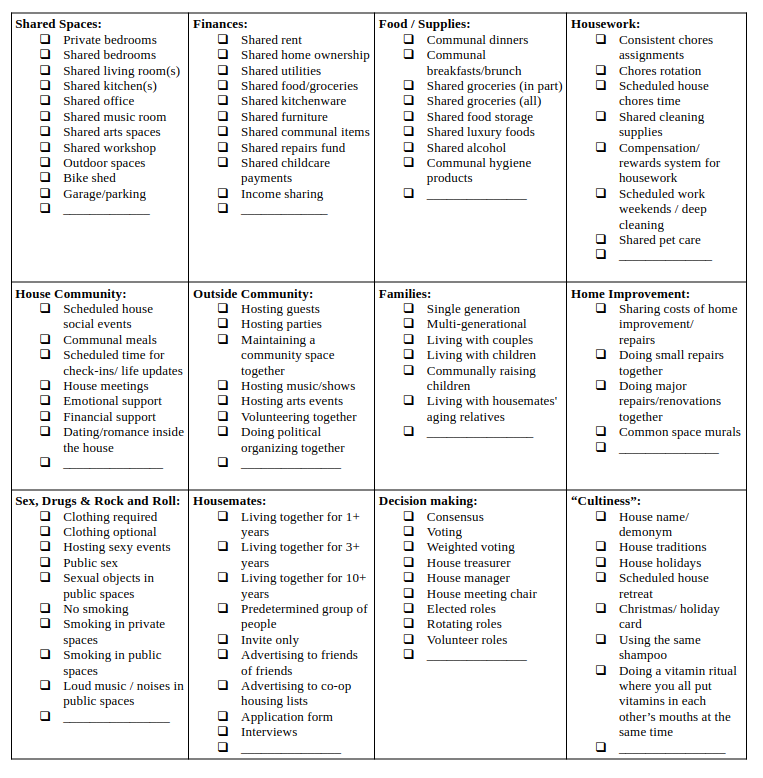
As another community of people who are interested in imagining kinds of relationships that there isn’t a clear template for, polyamorous people have generated a lot of exercises and worksheets to help others imagine what sorts of intimacy or entanglement they want their relationships to include. One of these approaches which I’ve found very helpful in my co-op life is a tool which is sometimes called the “relationship menu” or sometimes “the relationship anarchy smorgasbord.” The relationship menu is a worksheet which lists different categories of intimacy as a tool for mapping what kinds of intimacy partners in a relationship are or aren’t interested in in a particular relationship. For instance, a menu for a romantic relationship might have categories for exclusivity, entanglement of families, physical and sexual intimacy, financial entanglements, or co-habitation. Participants in the conversation can each fill out their own copy of the worksheet to collect their thoughts and feelings, and then share their worksheets use them as a starting off point for a conversation about what’s going to work for the relationship as a whole. Some people like to use a pre-existing template for a relationship menu, and some people like to make their own. Answers on a relationship menu don’t need to be any kind of promise, or permanent preference – many people can decide they want different things out of a relationship over time, or want different things from relationships with different groups of people.
Since different people often approach co-housing with their own ideas of how entangled with their housemates they intend to be, I’ve found relationship menus to be a very useful tool in imagining what a group of housemates want a co-housing situation to look like. In my current co-op, we recently did this in the form of a survey: we created a many-part questionnaire and had everyone input their preferences as a starting point for our conversations about what we want our residence agreement to look like. The structured questionnaire was helpful for holding the full space of possibilities in our minds before deciding on something, and making sure that nothing got lost in that very expansive conversation. A tool like this is especially useful when imagining and creating a new co-op community. But I think it could also help in a conversation about changing up commitments with current housemates or debugging what’s not working in a current housing situation.
Below, I’ve included a draft of a potential relationship menu for co-housing (based somewhat on the survey that my house used). Obviously, my template isn’t the only approach – I’ve tried to include on it things which are important to me, but I strongly encourage you to create your own templates with things which are important to you!
Trust-Based Communication
An inconvenient fact about inviting people into your life (love life, house, etc) is that there will be moments when your preferences, desires, or needs conflict with each other’s. And the more people with different preferences and desires that you involve in a situation, the more compromises you might have to make. Making these kinds of compromises is often what makes people most anxious about co-housing or polyamorous relationships – and with good reason! When we make something as central to our lives as a relationship or a home, it’s important that it feels welcoming and comfortable, even when we’re tired, even when we’re grouchy, even when we’re not at our best. No one wants to be returning everyday to a situation where they’re making trade-offs they’re unhappy with. Being able to negotiate competing preferences is one of the big problems of co-housing and of polyamory – and when it’s not working well, it can be one of the worst stressors.
When people are feeling worried that their desires and needs won’t get met, it’s a common instinct to defensively draw a wider circle around their desires than they actually need. When we’re afraid of a partner falling in love with someone else and abandoning us, it’s easier to say “don’t date anyone else.” When we’re afraid that our roommate might have a cat who pees everywhere, it’s easier to say “no pets.” This isn’t an unreasonable instinct– if a need is really important to me and I worry I’ll have to bargain down from it, why wouldn’t I ask for more than I expect to get?
Drawing very wide circles around desires can be pretty manageable in relationships which involve fewer people. Many people have the kind of relationship where only one partner decides the whole grocery list, or all the interior design, and so long as you both don’t happen to have strong contradictory preferences about the exact same thing, it works out okay! But if you do live the kind of lifestyle where more people are involved in this equation, it becomes difficult to have conversations about what to do as a group, unless people are willing to be much more compromising, and to communicate their needs and desires more specifically. Otherwise, communications quickly become an arms race, where everyone feels the need to state their desires in the strongest possible terms, to be ensured that any of their preferences are met at all.
Living in co-housing and polyamorous relationships can be stressful because they involve giving up control to accommodate more people’s needs. When people say things like “I couldn’t be polyamorous, I’d get too jealous” and “I couldn’t live with roommates, I’m way too particular about my living space,” I think they’re often pointing to the same fear – I wouldn’t feel comfortable having less control over my relationship/living space, because I don’t trust the people I’m with to make sure that my preferences are met if I give up that control. In my own experience, I’ve found that often, giving up control in this manner can be nerve-wracking. But it can also be immensely freeing. Some of the most rewarding moments of co-op live for me have been times when I thought I needed something big and hard to find, but took a leap of faith and realized that with the support of my community, I could be contented with something small and easy to get: for instance, when after weeks of stressing about not having enough storage space unless I had one of the highly-sought after big rooms, I volunteered to take the little room in my house which no one wanted on the condition that my housemates helped me think through storage solutions, and found that that small room was actually really cozy and all that I had really needed was to stash a few boxes in someone else’s closet.
A lot of very smart polyamorous writers have pointed out that the thing that makes people comfortable with ceding control in a relationship is often trust - specifically, trust that if you draw a smaller circle around your desires, other people will work with you to make sure your needs will still get met. When you trust your partner to not abandon you if they fall in love with someone else, you can draw lines at “I want to hang out with you alone on our special date night” rather than “I don’t want you to be with anyone else, ever.” When you trust your housemates to do their best to be sensitive to your needs, you can ask “can you be sure your guests clean up after themselves and put their dishes in the dishwasher” instead of “no parties.” When you trust your community to be willing to re-open conversations, and trust yourself to be able to introspect and communicate a hard line when you need it, you open up the possibility to say “I’ll give it a try, and we can talk about it again if this isn’t working for me,” rather than “no.” And, conversely, when our housemates trust us by making a compromise or trying something out on our behalves, we have to honor and reward that trust by doing our best to make sure that their needs get met another way, and giving them the option to change their mind. Trust allows you to take an “us vs. the problem” mentality when talking through conflicting needs rather than a “me vs. them” mentality. When you trust that you and your housemates are mutually working towards the goal of making sure everyone’s needs are met, you can communicate more clearly about your actual needs – rather than having to communicate opaquely and defensively, you can give your housemates all the specific puzzle pieces to fit together into a living situation everyone is happy with.
People in the polyamorous community have put together a lot of great worksheets and heuristics to help people think through communicating emotional needs in specific and non-confrontational ways. These tools are often framed in polyamorous writing as tools for combating jealousy – but in my experience in co-housing, I’ve often found them equally helpful for communicating about other kinds of interpersonal situations which make me feel defensive and panicked that I won’t get what I need. So here is a worksheet (loosely cribbed from Polysecure) that might help folks in co-housing approach how to communicate about their wants and needs which might conflict with their housemates (alongside an example of how I saw someone model this very well at a house meeting a few weeks ago):
- Notice the problem.
- Name the emotional response (e.g., I am feeling anxious)
- What specific situations seem to trigger the feeling? (e.g., Whenever we have discuss planning a party at house meetings, I get nervous)
- Are your emotions in response to something that is happening, or something you are worried might happen? (e.g., I am worried that the house will be too loud and I will be uncomfortable)
- Identify the underlying need.
- What do you need to feel comfortable in this situation? (e.g., I get stressed out when I’m at a loud party and there’s nowhere quiet I can go.)
- What would be the bare minimum which would meet this need? What would comfortably meet this need? (e.g., I need my room to be quiet when I go to sleep at 11pm. Ideally, I would like a quiet space I can hang out at while the party is going, which could be my room or somewhere else.)
- Explore solutions.
- Think of solutions which would make sure your needs are met, starting with solutions you can implement on your own. (e.g., I could try better soundproofing my door or getting earplugs to sleep)
- If those don’t meet the need, move on to solutions which involve fewer people, and then solutions which involve more people. (e.g., We could ask for the floor of the house that my room is on to be a quiet space during the party, we could ask guests to leave or be quiet after 11pm)
- Communicate a specific ask.
- Communicate your ask to your housemates. (e.g., Can we ask people to only party quietly and not have music playing on the first floor, and ask party guests to move to the second floor after 11pm?)
This doesn’t all need to be a conversation that happens in your head either! Your housemates are your friends, and sometimes, it can be really helpful to get other people’s help with brainstorming solutions they wouldn’t find overly constraining, or even parsing out what parts of the situation are stressors for you. But I’ve often found that, in general, the more that people who live in a co-op trust their housemates and make communicating needs in this kind of style second nature, the smoother conversations about shared spaces and diverging preferences can go.
In Conclusion
Obviously, parallels between polyamorous communication and co-housing communication is a big topic, which I could share a lot of thoughts about for a long time. And I for sure don’t pretend to have it all figured out either – in my romantic relationships, or in my co-housing relationships! But I have personally found thinking about these parallels helpful in some moments of difficult co-op communication, and I hope that this post can be at least a useful introduction into thinking about how tools developed by one community could be useful for thinking about the other.
I’d be interested to hear more in the about other people’s experiences with polyamory and co-housing, and if you have any ideas about how tools from one can helpfully be applied to the other, please reach out!
If you have questions for this author or about the blog more generally, please reach out to info@conviviality-cooperatives.com. If you wish to propose or submit your own article, please see our submissions instructions.