Jack Reid (he/him) currently lives in a nine-person, jointly owned co-op in Somerville called the Vivarium. He has been living in one co-op or another (all in Camberville) since 2016. He is also the editor/webmanager of the Conviviality blog.
legal disclaimer: I am not an lawyer and cannot provide legal advice. The following is based on my own experience and may not apply to you.
author’s note: If you are just looking for an example contract, you can find that here. If you are looking for a lawyer to help your co-op write up a contract, I recommend Lee Goldstein. There are lots of types of co-op ownership and many steps involved with buying a house. This article only deals with a tenancy-in-common contract. Finally, the contract discussed in this article was signed on March 5th, 2025, approximately ten months ago at time of writing. Readers are cautioned to maintain some, well, caution when considering the efficacy of this particular contract.
When friends, family, or more distant associates learn that I live in a jointly owned co-op, one of the more common responses is: “Oh really? How does that work? What if someone wants to sell? Do you have some kind of contract?”
The answer, of course, is yes. A contract was a crucial part of our collective home-buying process. That said, I think most of those curious inquirers have a fairly mistaken idea of precisely why a contract is important for a property-owning co-op. In the approximately ten months since we signed our contract and moved into our house, we talk about or reference our contract approximately never (unless answering an outsiders question). The contract simply isn’t relevant to our day-to-day decision-making and, to be honest, that’s how we like it. How can this apparent irrelevance of the contract and my claim of its cruciality both be true at the same time? That’s what I’m going to talk about today.
What is a contract?
In this context, a contract is a legally binding agreement between multiple people. A contract should address topics that fulfill the following conditions:
- Serious enough that you are willing to involve a court in the event that someone violates the agreement.
- Stable enough that frequent changes and amendments aren’t necessary.
- Clear enough that you can write it down in specific, enforceable language.
The vast majority of co-op decisions, rules, and norms don’t need be (and shouldn’t!) be in a contract. Your weekly grocery list, your chore schedule, your operating budget, and your infectious disease precautions all probably don’t belong in a contract, as each violates one or more of the above conditions. Running to a lawyer every time the local grocery store stops carrying some house staple is going to be quite cumbersome (and expensive).
This is not to say that these topics aren’t important or worth writing down. Establishing clear norms and expectations, along with having an explicit process for making collective decisions, is crucial for a co-op to function properly and avoid the tyranny of structurelessness. I just mean to say that these topics probably don’t belong in your lawyer-reviewed contract. This is why our contract includes the following section that carves out a pretty darn big domain as not in scope of the contract itself:
1.5 Resident Decision-Making The legal residents of the Property (to be referred to in this Agreement as the “Residents”), including both Owners residing at the Property and adult tenants, shall make any decisions regarding the governance of Residents, the accepting of new Residents, eviction of Residents, house maintenance and improvement, setting and division of rent, and the raising and use of house funds… The initial Resident decision-making process will require the consensus of all Residents except one (this method is referred to as “N-1 method” for the purposes of this Agreement). For the purposes of this Agreement, “Consent of the Residents” will be used to refer to decisions made by Residents using the N-1 method or whatever other process the Residents may later adopt. Residents can amend or replace their decision-making process by Consent of the Residents…
Instead, a contract should focus on topics like how decisions are made, what to do if someone wants to liquidate their stake in the house, how to onboard new co-owners, or what happens if someone dies unexpectedly. But before we get too much into the contents of a contract, we should first establish why a co-op would event want or need one in the first place. Surely we can just trust each other, right?
Why have a contract?
The most obvious purpose of a contract is to have a piece of paper that you can show to an arbiter or a judge to elicit this response: “Oh yes, you are quite right. I shall now enlist the power of the state to resolve this dispute as specified on your piece of paper.” This is not the most important purpose of a contract for a co-op, however. Ideally, you never end up in a courtroom facing off with your current or former housemates at all (inshallah). And that is precisely the true purpose of the contract – to prevent a dispute from escalating in the first place.
A contract accomplishes this in two ways. The first is clarity (and ideally fairness) in high-stakes situations. Trying to navigate a dispute with tens of thousands of dollars (or more) on the line from first principles can be stressful to say the least. It’s all too easy for self-interest or personal animosity (or even just the perception / potentiality of either) to creep in, sabotaging the discussion. To use a low(er) stakes example, there’s a world of difference between having a discussion about kitchen cleaning policies and adjudicating how Theresa has been personally insulted by Juno’s repeated dirty dish abandonment. Contracts, and written agreements more broadly, preempt such devolution by establishing clear rules and procedures up front and in the abstract. They provide a step-by-step guide for the tough situations where likely no one involved is their best selves.
So contracts tell a judge what to do in a court and tell your house what to do before that. A contract does yet another thing even earlier, however. A contract provides a safety net and thereby provides a sense of security. It establishes the worst-case scenario in the event that some otherwise minor argument spirals out of control. A key part of feeling safe and secure is knowing that you don’t have to win every argument, that what you value is protected, and that you have a way out of the situation if you need it. Theresa and Juno (and the rest of the house) can work out their dirty dishes dispute without worrying about whether either will be out on the street without a penny to their name. Ideally a contract provides that secure and provides that way out.
How does this shake out in practice? Let’s look at a specific contract.
What’s in a contract?
Obviously you need to talk to a lawyer to make a contract happen. Before that, though, it can be helpful to have a sense of what you want the contract to accomplish. When the group of people that would become the Vivarium, my co-op, were discussing a potential contract, we kept revolving around two central principles.
(1) The contract shall provide a graceful exit. Folks who would soon be contributing large sums of money to a downpayment and signing onto a thirty year mortgage shouldn’t feel like they were lighting their money and future on fire. If desired or needed, each person should feel free to leave and to retrieve their money, while not overburdening the remaining folks.
(2) Decision-making and social status should be kept as egalitarian as practicable. Someone who contributed more to the downpayment shouldn’t have more of a say on living room paint color, higher priority when selecting chores, or more of a say one which maintenance or renovation project happens next.
There’s a natural tension between these two principles. Plenty of house decisions can impact the value of the property, so someone with a ton of money sunk into the house may have feelings about those decisions. Most of our contract is working out this tension where it exists and fleshing out the two principles were it doesn’t. We didn’t do this from scratch, however. We procured the services of a local lawyer familiar with Massachusetts co-ops. Lee Goldstein has been assisting groups such as the Vivarium for about fifty years now. He even wrote a book on the topic back in the 1970s! Lee provided us with three (anonymized) contracts from past engagements. We constructed our own contract by copying bits and pieces of each, then editing and expanding upon the assemblage until it suited our needs. After some rounds of edits and suggestions from Lee, it was ready and we could proceed to look for a house to buy.
The following sections walk through some of the more notable sections of the contract, with reference to the above two principles. You can read the full (anonymized) contract here
House Shares
The primary way we upheld principle (1) is through the mechanism of house shares. The basic concept of these shares is similar to shares in a publicly traded company. If you own one share out of one hundred shares, you effectively own 1% of the company. The initial distribution of shares was based on contributions to the downpayment and closing costs of the house. Additional shares are generated by paying off the mortgage principal (part of our monthly “rent”) or for contributing to certain home maintenance and renovation projects.
1.1 Initial Distribution of Ownership… Ownership interests in the Property shall be measured in “Shares.” The issuing, transfer, and ownership of fractional Shares are permitted, each in accordance with the other terms of this Agreement. Except as modified in the future by the other terms of the Agreement, each Owner shall have the following Shares in the Property, reflecting contributions of each Owner to the initial downpayment and closing costs…
2.1 Paying off the Mortgage As the mortgage principal is paid off, additional Shares shall be issued proportionately to those who contribute
2.2 Maintenance, Repairs, and Improvements Additional Shares may be issued to compensate for financial, labor, or in-kind contributions to home maintenance and improvement projects.
The important next question, of course, is what can you do with these shares? Well you can sell them to other Vivarium owners or residents. This is the primary mechanism by which an owner would completely exit from the situation. Maybe their career plans changed, they are going to move across the country, and they need the money to start over. Maybe a family member fell ill and money is needed for support. Or maybe (God forbid), they just want nothing more to do with the rest of us. Whatever the reason, any of us can sell our shares and move on with our life. Keep in mind the last clause of Principle (1), though: “while not overburdening the remaining folks.” The contract has a built-in time period for the sale to take place over, so that the remaining residents can gather the sufficient cash to make it work. And if we can’t make it work, well, then the house has to be sold. Them’s the breaks.
5.3 Selling Shares At any time, an Owner (referred to in this section as “the Seller”) may choose to sell some or all of their Shares …. When the Seller does so, Residents and other Owners shall be given four (4) weeks to reach an agreement for the purchase of the Shares…. If not all of the proffered Shares are purchased by this process, the Residents and other Owners shall have another eight (8) weeks to reach an agreement (among themselves, not including the Seller) on a payment plan to the Seller. A payment plan may take longer than one (1) year to purchase the shares if and only if the Seller agrees to a longer period. If the Residents and other Owners cannot reach such an agreement within the allotted eight (8) weeks (a total of 12 weeks from when the Owner declared their intent to sell), the selling Owner shall have the right to offer the entire Property for sale to the general public.
Obviously this is a compromise between full autonomy for each owner and the welfare of the house as a whole. That’s part of living in a society. Other groups may tilt the compromise further in one direction or another, and that’s fine! The contract should reflect the values and needs of your particular co-op.
Whether the house is sold for this reason or another, the proceeds are divided proportionately to share ownership. You own 1% of the shares, you get 1% of the net proceeds.
6.4 Proceeds In the event of a sale of the Property… then the Owners shall divide the net proceeds received in proportion to their interests in the Property. “Net proceeds” shall be defined as any funds received, less the amount, if any, of any unpaid portion of the mortgage principal, and also less any closing costs, broker’s fees, legal fees, or other costs associated with the sale or destruction of the Property. The division of the net proceeds shall not be affected by the current or past status of the Owners as residents of the Property; that is, an Owner who shall have resided in the Property for a greater total length of time than another Owner shall not, thereby, be entitled to a greater share of the net proceeds.
Note the final sentence of the quoted passage. This is another compromise. Money is just one way that a person can be committed to a house. Simply by living in it, one contributes labor, camaraderie, and character to the house. While such contributions can be difficult to quantify, it is possible to recognize them in a contract. We chose not to, but you should seriously consider whether you want to choose differently.
Being able to sell them is not all that owning shares does, however. Owning shares also entitles you to participate in various kinds of decision-making about the house. Some of these are independent of the number of shares owned (more on this in a bit). Others are more directly related to the monetary commitment a person has in the house. One is making the decision to sell an insolvent house.
5.4 Selling During Insolvency If, at any point, insufficient funds are available to pay for mortgage payments, utilities, or taxes, Owners may vote to sell the Property with a threshold of greater than or equal to 25% of Shares (excepting any Shares held by heirs who are not full participants in this Agreement). If this is done, the Owners shall have the right to offer the entire Property for sale to the general public under the terms of Article VI.
Why a 25% threshold? Why not just make the sale automatic in the case of insolvency? Well there are many different kinds of insolvency, some more temporary than others. We decided to trust our future selves and other future Vivarium owners to make that call. And if they really want to go down with the ship, well, that’s their prerogative. You can’t save someone from themself.
The other share-dependent decision-making process is amending the contract itself. No static document can account for the dynamic world that we live in, so you always want to have a process for making changes to the contract without having to start over from scratch.
8.1 Amendment Process This Agreement shall not be amended except by either (a) Consent of the Residents and a vote by Owners constituting >60% of Shares (excepting any Shares held by heirs who are not full participants in this Agreement); or (b) unanimous consensus of Owners. If this Agreement is amended, Owners shall be given a 1 month opportunity to initiate the sale of their Shares under the terms of the Agreement prior to the amendment.
Ignore the “except for the heirs” things for now, we’ll get into that later. Here we have two mechanisms for amending the contract, one share-dependent and one share-independent. I do want to flag the final sentence of Section 8.1 though. This is another important graceful exit mechanism. The contract can be amended over the vociferous objections of an adamant recalcitrant, but that person can then exit under the terms of the contract that they did agree to. We intended this to avoid handing unilateral veto power to any one individual, while still complying with Principle (1).
Decision-Making
Those two share-dependent decision-making authorities are pretty niche, however. And if you recall earlier, a huge swath of day-to-day decision-making is excluded from the contract altogether. This is where Principle (2) comes in. We chose to protect individual interests primarily by providing them with opportunities for a graceful exit. Ongoing decision-making, meanwhile, should be kept egalitarian.
Section 1.5 (Resident Decision-Making), quoted earlier in this article, does the heavy lifting in this regard. The contract distinguishes between “Owners” (who own shares) and “Residents” (those who live in the house). Generally residents manage their own affairs, including dividing up monthly expenses. When I quoted the section earlier, I skipped over some parts for simplicity. Let me show the full section now, with the previously skipped parts italicized.
1.5 Resident Decision-Making The legal residents of the Property (to be referred to in this Agreement as the “Residents”), including both Owners residing at the Property and adult tenants, shall make any decisions regarding the governance of Residents, the accepting of new Residents, eviction of Residents, house maintenance and improvement, setting and division of rent, and the raising and use of house funds. The collective rent shall be at least sufficient to cover scheduled mortgage payments (including payments towards both the principal and interest), property taxes, and utilities. Once the mortgage of the house has been paid off, the collective rent shall be at least sufficient to cover property taxes and utilities. The collective rent may be set higher in order to cover expenses such as, but not limited to, renovations, maintenance, and social events. The initial Resident decision-making process will require the consensus of all Residents except one (this method is referred to as “N-1 method” for the purposes of this Agreement). For the purposes of this Agreement, “Consent of the Residents” will be used to refer to decisions made by Residents using the N-1 method or whatever other process the Residents may later adopt. Residents can amend or replace their decision-making process by Consent of the Residents. Residents may choose to extend Resident status to minor tenants via Consent of the Residents.
We defined the “collective rent” here in part so that we have a more clear definition of insolvency for Section 5.4. If the residents aren’t upholding this section, maybe the house needs to be sold. In general though, the residents (which note doesn’t include any non-resident owners) get to run the show using their own decision-making processes. How rent is divided up? That’s the residents (Sections 1.5 and 2.1). What maintenance, repairs, and improvements happen? That’s the residents (Sections 3.1 and 3.4). How much money gets set aside for maintenance and improvements? Also the residents (Section 3.2). And if it isn’t in the contract? The residents once more (Section 1.5).
This is not to say that the owners down’t have any oversight short of selling their shares (or the house entirely). The contract does specify a variety of decisions that require approval from the owners. Even here, though, the decisions are egalitarian among the owners, not dependent on the specific number of shares each person has.
1.6 Owner Decision-Making The Owners shall attempt to make all decisions regarding the Property by unanimous consent. However, if after good faith effort such consent cannot be achieved, and except as provided elsewhere in this Agreement, decisions may be made by agreement of all of the Owners except one. For the purposes of this Agreement, “Consent of the Owners” will be used to refer to decisions made by Owners in this way.
Only the owners have the authority to write checks from the house bank account (Section 1.11) or to commit to spend money beyond the amount in the bank account (Section 3.1). If the house is seriously damaged, it is the owners who decide whether to commit to rebuilding or not (Section 3.3). Both the residents and the owners have to sign off on issuing new shares in exchange for contributions to a maintenance or improvement project (Section 2.2) or on using the house for commercial purposes (Section 9.6).
Hopefully you are starting to see the general theme here. Owners don’t have a say in how the house is generally run, but they do have a say on if the house gets burned down or foreclosed upon. And, of course, an owner can always pack up and leave. All of this represents a pretty robust inclination towards egalitarianism, which is the way we wanted it. That said, there is a pretty significant weak point here. What if a small portion of the owners and residents own all the shares. At one extreme, we could imagine one person owning 90% of the shares in a nearly payed of house. That person may not officially have any particularly large decision-making authority, but what if they suddenly demand to sell of their shares and the rest of the house cannot come up with the money, even within the 1 year payment plan period specified by the contract? You can see how the threat of this, explicit or implicit, could distort community decision-making, regardless of what is written down on the piece of paper. Guarding against this possibility represents another major component of our contract.
Incentives towards equal ownership
Throughout the contract are a few sections (or even portions of sections) that are intended ton incentive distributed, rather than concentrated, ownership of shares. First, there’s the aforementioned fact that the residents, in an egalitarian manner, are given charge for dividing up rent (and thus monthly mortgage payments) among themselves. At time of writing, we divide rent up evenly on a per-person basis. This means that, even though we contributed varying amounts to the initial downpayment (and thus started out with varying numbers of shares), we will tend towards equality over time.
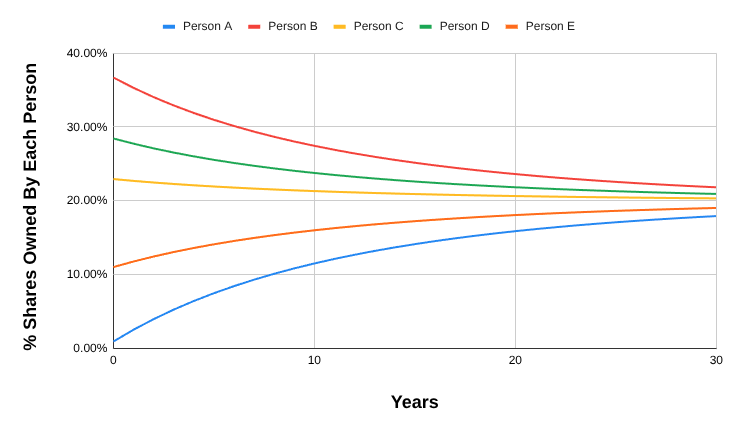
We didn’t want to just be stuck with waiting for time to solve the problem, however, so we included some other provisions that encourage distributed ownership. In Section 2.1 (Paying off the Mortgage), we have:
If any Resident or Owner wishes to make voluntary payments to the mortgage principal, other Residents and Owners must be notified. All Residents and Owners shall then have an opportunity to make voluntary payments themselves. The order of these payments shall be Residents first, then non-resident Owners. Within each of these two categories, the order shall go from those who own the fewest Shares to those who own the most Shares. In the advent of a tie using this mechanism, order shall be determined among the tied individuals using a coin flip or comparable fair and random method.
Later on, we have a section that provides for a mechanism by which someone can force another person with more shares to sell some of their shares at a set price.
5.1 Purchasing Shares At any time, a Resident or Owner (Person A) may choose to purchase Shares from the person(s) who has the greatest number of Shares (Person B), up to the point at which Person B no longer has the greatest number of Shares. Person B cannot decline to sell these Shares at their current monetary value. Person B can choose to sell those Shares at less than their current monetary value as defined by Section 5.5.
Section 5.2, which is primarily aimed at addressing the hypothetical problem of an absentee Owner whose interests no longer align with the house, also has language that mirrors that of Section 2.1
5.2 Purchasing Shares from a Non-Resident Owner At any time, by Consent of the Residents, a nonresident share owner may be compelled to sell some or all of their Shares to one or more of the residents at their current monetary value, as defined by Section 5.5. If this occurs, priority for the purchase of the Shares shall be given to Residents first, then non-resident Owners. Within each of these two categories, the order shall go from those who own the fewest Shares to those who own the most Shares. In the advent of a tie using this mechanism, order shall be determined among the tied individuals using a coin flip or comparable fair and random method.
All of these provide ways for someone with fewer shares, such as a new Resident-Owner, to acquire more from whomever has the most. And the contract provides some amount of benefit even if no one avails themselves of this options, simply because it is more difficult to lord their shares over others if those shares can be taken away. Now you may be thinking,”But you aren’t taking them away, you are buying them. What if no one has the extra cash to splash around like that?” This is a very good point! It strikes at something that I have been skipping over amid all this talk of buying and selling shares: the price of a share.
Price of Shares
There are a lot of ways of putting a price on shares, none without their downsides. The fundamental problem is that we aren’t dealing with a open, liquid market, where the price of something is simply whatever you can convince someone else to buy it for. If we used that system and an owner wants to sell their shares and the rest of us are just offering (the recently discontinued) pennies, the seller is stuck with it unless we sell the house. This hardly allows for a graceful exit. So we have to figure out how to set the price of a share. Thankfully, we hardly lack for options. Most consist of [Value of House]/[Number of Shares] where [Value of House] is determined in different ways. Here are a few that we considered (with varying levels of seriousness):
- Value of the house at time of purchase.
- Increase the value of the house each year by the national inflation rate.
- Adjust the value of the house each year by the relative change in some indicator of the national economy, such as the S&P 500.
- Adjust the value of the house each year based on changes in average property values in Somerville.
- Adjust the value of the house each year based on the relative change in the local cost-of-living.
- Match the current municipal property value assessment (used for property taxes)
- Periodically hire a professional appraiser.
- Periodically identify comparable houses sold in the neighborhood and use those to estimate the current value of our house.
- Periodically pretend to put the house on the market and see what people offer.
Obviously none of these are perfect. Most are using proxies that are at best indirectly related to the actual home value. Some require a fair amount of work to calculate and a few would cost actual money in-and-of themselves. Many would result in discontinuities at some point in time that could introduce incentives (perverse or positive). Rather than walk through each of these individually, I will just explain what we chose and why.
For so long as the mortgage is in effect, the value of the Vivarium is set at its purchase price. It does not go up or down and thus the nominal dollar value of the shares is constant (assuming we don’t issue additional shares for maintenance or renovation projects). Then once the mortgage is paid off, we switch to using the municipal Somerville property value assessment, which tends to less than the actual market value of a house. When we bought our house, for example, the municipal assessment was about 15% less than what we purchased it for. We can reasonably expect (though by no means guarantee) that the house will appreciate in value by more than 15% over the course of the 30-year mortgage. This means that the moment we pay off the mortgage, the values of our shares will jump upwards to match the municipal assessment.
I recognize this seems a bit odd. The price stays the same for 30 years then jumps upwards? Why? Well, there’s a few interconnected reasons.
First, simplicity. None of us really wanted to spend time and money doing a more complicated calculation. Ain’t nobody got time for that.
Second, the house is not a short-term financial investment mechanism. While we want owners to be able to exit gracefully and get back what they put in, this is a place for people to live, not an index fund. Yes that does mean that if someone sells out five years in, they get out what they put in in nominal dollars rather than real dollars, but that’s a compromise we were willing to make. Plus there’s always the possibility that the Boston area will actually commit to solving the housing shortage and housing prices will fall (I know, let me dream). In that scenario, the selling owner would actually be doing better than selling the house itself.
Third, incentives. By keeping the price constant, we enable future resident-owners to buy into the house in an increasingly affordable manner. We also encourage owners to hold onto their shares until the house is completely paid off. Yes, maybe this means there will be a mad scramble to pay off the mortgage principal right at the end and to force those with more shares to sell to those with fewer, but neither are exactly terrible problems to have. They are also won’t become relevant for almost three decades in the future and it’s awfully hard to make any predictions about the kind of people the set of Owners will be (even if I myself am still among them). We considered this preferable to having a discontinuity at the moment of purchase, which would have discouraged folks from contributing to the downpayment (and thus prevented us from buying a house at all). I’m not saying this is perfect, but we think it will work for us (and has thus far at least).
This selection is embodied in our contract as follows:
2.1 Paying off the Mortgage As the mortgage principal is paid off, additional Shares shall be issued proportionately to those who contribute such that: V=(H-M)/N, where V is the price of each additional share; H is the initial purchase price of the house, including any closing costs; M is the remaining, unpaid mortgage principal; and N is the current number of Shares.
5.5 Value of Shares For the purposes of this Agreement and prior to the mortgage being paid off, the current monetary value of a Share will be defined as the price of Shares as specified in Section 2.1. After the mortgage has been paid off, the current monetary value of these shares will be considered to be the assessed value of the house as determined by the municipality for the most recent fiscal year for which data is available.
What if…?
Remember that a major role of a contract is to provide step-by-step guides for stressful situations. Many parts of our contract have less to do with our two principles and more to do with various contingencies of varying likelihoods. Let’s call these the “What if?” clauses.
What if someone gets hit by a bus? You can distinguish between a personal hobby and an institution by asking this question. Can the rest of you pick up and keep going? You are an institution with some resilience. If the whole operation falls apart? Then you were’t a real organization, you were just that person’s hobby. And if you signed onto a 30-year mortgage, the chance that someone dies at some point is very much nonzero. So it is prudent for us to think about that. Our answer? You can will your shares to whomever you like, but they don’t get to participate in decision-making unless they full join the community and this contract (which requires consent of the current community members). And in the event that you are just disabled in some sense, the rest of us can carry on with our decision-making.
1.2 Incapacitation and Inheritance In the event that any Owner dies, or becomes ill, mentally disabled, incompetent, or otherwise incapacitated (the phrase “incompetent Owner,” as used in this document shall include any such condition other than death), the remaining Owners shall equally share full rights to control and make decisions concerning the Property. No other agent or guardian, nor any heir, beneficiary, legatee, donee, executor, administrator, trustee, assign employee, successor in interest, or anyone else acting on behalf of an incompetent Owner, shall have the right to participate in decisions concerning the Property. In the event of any Owner’s death, the deceased Owner’s interest in the Property may pass to their heir(s) or beneficiary(ies); however, such heirs or beneficiaries shall not have rights to participate in decisions concerning the maintenance, sale, rental, or other control of the Property. If the heir(s) or beneficiary(ies) are already a Resident, they will be allowed to join the Agreement in full. If they are not already a Resident, or if they decline to join the Agreement, the heirs’ or beneficiaries’ interest shall be restricted to the right to receive their share(s) of any equity, if and when the remaining Owners shall decide to sell the Property.
What if a resident is misbehaving? Depends on what you mean by misbehaving. If it is isn’t something covered in the contract (like being a general asshole), well, that’s the business of the residents. Section 1.5 clearly states that “eviction of Residents” falls in their domain, not the contract. So if they want to kick someone out, they can.
What if that resident is also an owner? Ah yes, that’s a bit more complicated. First off, being an owner doesn’t prevent you from being evicted by the residents. Egalitarian decision-making and all that. But it is not unreasonable to expect that if someone warranted getting evicted, we probably don’t want them involved in the house decision-making as an owner either. In that case, we can avail ourselves of a section that we actually talked about earlier for a different reason:
5.2 Purchasing Shares from a Non-Resident Owner At any time, by Consent of the Residents, a nonresident share owner may be compelled to sell some or all of their Shares to one or more of the residents at their current monetary value, as defined by Section 5.5…
Then, at the tail end of Section 5.2, we have “Any Owner who sells all of their Shares shall no longer be considered an Owner and shall be removed from the Agreement.” So in summary, if an owner is misbehaving, first residents have to evict them, then the residents can force them to sell off their shares, thereby booting them off of the contract.
Okay but what if by misbehaving we mean violating the contract? There the owners can initiate recourse themselves, though the specific form of this recourse is still dependent on what exactly the person did. Let’s try and be more specific here.
What if they serious damage part of (or all of) the house?” Well there’s the first part of Section 3.3. “The Owners agree to equally bear the risk of any casualty loss to any portion of the Property, except where such loss is the result of the negligence or fault of any Owner, in which case the loss shall be borne by such Owner. “
What if someone is interfering with the sale of the house? Selling our collective home is likely to stir up emotions. While the contract allows us to sell the house over the objections of any one individual, a particular obstinate person may try to prevent the sale anyways. For that we have the following:
6.2 Interference If despite the existence of a purchaser willing to purchase the entire Property at its fair market value, and the desire of one or more Owners to sell the Property to the purchaser at the offered price, the other Owner or Owners fail or refuse to do so and to execute all documents necessary to effect such a sale, said Owner or Owners shall be liable to the other Owner or Owners for all loss, damage, and expense, including reasonable attorney’s fees, caused thereby. This obligation may be enforced by specific performance in addition to any other remedies at law or in equity.
What if the owner is just generally not holding up their end of the bargain in the contract? Always good to have a more general catch all. For that we have a combination of three sections that mutually seek to shore things up.
4.1 Individual Owner Default In the event that an Owner defaults in the payment of their share of joint expenses as provided above, or is otherwise in default of their obligations under this Agreement, and remains in such default for a period of fifteen (15) days, the other Owners may serve upon such defaulting Owner written notice of the default. If the defaulting Owner fails to remedy such default within thirty (30) days of receipt of such notice, or fails to give notice that they desire to enter binding arbitration pursuant to Article VII hereof, which arbitration shall not take more than twenty (20) days, the remaining Owners may, at their option, demand that the defaulting Owner do either or both of the following: a) Vacate the Property immediately and allow the remaining Owners to lease or rent the defaulting Owner’s rights to occupy the Property to third parties of the Residents choosing; or b) Vacate the Property immediately and convey their rights title and interest in and to the Property to one or more of the remaining Owners or their designee, pursuant to the provision of Article V below, except that all arrears in the defaulting Owner’s share of payments, and other expenses incurred as a result of the default shall be deducted from the amount the defaulting Owner would otherwise receive from the remaining Owners or their designees. “Other expenses” so deducted shall include, but not be limited to, legal fees and advertising costs. 4.2 Right of Action If the defaulting Owner refuses or fails to comply with the preceding provisions of this Article, the remaining Owners shall have the right to bring an action in the appropriate court seeking specific performance of this Agreement, damages, other appropriate preliminary relief, reasonable attorneys fees, and interest accruing from the date of the default. 9.4 Breach The Owners acknowledge that a breach of this Agreement cannot be adequately rectified by monetary damages alone, and all Owners acknowledge the right of other Owners to seek specific performance in addition to all other remedies contained in this Agreement.
Who’s responsible for the mortgage at the end of the day if this whole thing falls apart? The original set of owners each signed onto the mortgage individually (yes, you can do that, one of us should write another article about that at some point). In the eyes of the bank, each of those signatories are responsible for the entire mortgage. They’d probably go after whoever they thought had the most money. Among ourselves, however, we have more specificity. If the house is still a going concern but the residents aren’t holding up their contractual responsibility to make the monthly mortgage payments, we have this provision:
1.10 Income and Expenses … In the event that the Residents fail to raise enough money to cover expenses, each Owner shall be responsible for a share of the following expenses proportional to their number of Shares: (a) mortgage payments; (b) real estate taxes and insurance payments; (c) all utilities….
If the U.S. economy collapses and we are forced to sell the house for less than the remaining mortgage principal, we have another provision (though, let’s be honest, what we owe to the bank is probably the least of our concerns in that situation).
9.8 Continuing Mortgage In Absence of the House: In the event that the House has been sold or the Owners otherwise no longer possess the house, but the mortgage has yet to be fully paid off, the Owners shall decide how to divide responsibility for mortgage payments by unanimous consensus. If Owners are unable to reach unanimous consensus, the arbitration process specified in Article VII shall be used to determine a division of responsibility for mortgage payments.
What if there is a dispute over the interpretation of the contract? Even if everyone is operating in good faith, no language is unambiguous (thanks Wittgenstein). Any contract worth its salt should have a mechanism for resolving such disputes. For us, that’s Article VII.
7.1 Arbitration Process In the event of any dispute between the Owners as to the interpretation of the exercise of any right, duty, or obligation under this Agreement, or as to the maintenance or sale of the Property or any interest therein, the Owners agree to make all reasonable efforts to resolve said dispute among themselves. If the Owners remain unable to agree, they shall choose an arbitrator mutually acceptable to all the Owners. If they are unable to agree on one arbitrator, the Owners shall choose three arbitrators mutually acceptable to all Owners and a decision shall be made by a majority of the arbitrators. The expense of such arbitration, if any, shall be shared equally among the Owners which are parties to the dispute. It is the intent of the Owners that such arbitrator(s) be asked to help the Owners reach a mutually acceptable agreement, and that decision be made by the arbitrators themselves only if the Owners remain unable to reach such an agreement. 7.2 Arbitration Enforcement The decision of the arbitrator(s) shall be binding, and enforceable in a court of law, including any order for specific performance made by the arbitrator(s). Other than to enforce the decision of the arbitrator(s) or as provided elsewhere in this Agreement, no Owner shall bring any action in court with regard to this Agreement. In the event of any court action to enforce the decision of the arbitrator(s), the prevailing Owner(s) shall be entitled to recover their costs and reasonable attorney’s fees from the other parties.
What if some random emergency crops up that you didn’t think of? Collective decisions are rarely quick decisions. Virtually anyone who has lived in a co-op can attest to this. Recognizing this to be the case, we put in provisions to allow us to operate more flexibly when absolutely needed. These sections are perhaps a bit more vague than I would like, but, hey, that’s just how life is.
1.7 Emergency Decisions In an emergency situation, if one or more Owners are unavailable, decisions may be made by the remaining Owner(s) insofar as this is necessary to take care of the emergency. An emergency shall be defined as a situation in which immediate action is required in order to prevent or limit damage to or loss of the Property or physical harm to the Residents or others on the property. The decisions described in this Section shall not require Consent of the Residents. 1.8 Urgent Opportunities The Owners recognize that a situation may arise in which a beneficial opportunity exists, but which may be lost if a decision is not made quickly (the term “urgent opportunity,” as used in this document, shall refer to any such situation). The decisions described in this Section shall not require Consent of the Residents.
There are a few more “What ifs” embedded in the contract, but they are minor enough and this article is already long enough that we should probably wrap it up here.
I make no claims that our contract is a marvel of jurisprudence, but it does provide us with the necessary framework for collective decision-making and a sufficient safety net that we felt comfortable making the major (and expensive) decision to buy a house together in Somerville. I am optimistic that it will continue to serve us well in the years to come, sitting in the background and rarely thought of. And if it doesn’t, well, may it at least provide us with the opportunity to simply walk away.
I don’t know what your situation looks like or what principles your co-op (potential or actualized) wants to prioritize. You may try to solve completely different problems than we did in your contract. Or you may decide to solve some of the same problems in a completely different manner. Either way, I hope this walkthrough of our particular case has been useful to you. Best of luck in your experiment in cooperative living!
If you have questions for this author or about the blog more generally, please reach out to info@conviviality-cooperatives.com. If you wish to propose or submit your own article, please see our submissions instructions.